Part 2: A family guide to 15 Precalculus curricula and online resources for AHSD mathematics planning
Once the pathway is clear, which Precalculus course fits?
Part 2 of 2 • Picking up where Part 1 left off.
Part 1 began with two things very close to my heart: mathematics and our students. In Part1, “Is This Grade 12 Mathematics Pathway Sufficient for University in South Africa?”, we separated formal school-leaving recognition from actual mathematical readiness and asked what learners need before first-year university mathematics. [1]
This second article grew out of the very next question families often ask us: “That helps us understand the pathway, but which Precalculus course should my child actually use?” On paper, many options carry the same course title. In practice, their content, pacing and teaching style can differ considerably.
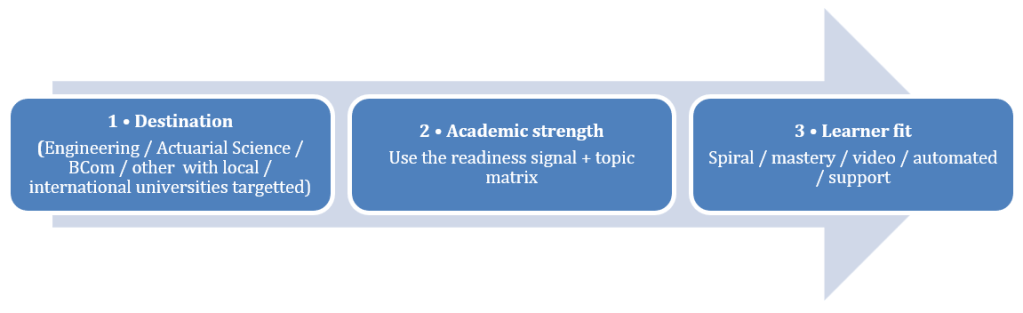
My hope is not to simplify the decision by giving you as families a clearer filter: begin with the learner’s likely destination, check that the mathematics is strong enough for that destination, and then choose the course the learner is most likely to engage with and master. A course only helps if the student can truly learn from it.
| Scope note for South African families Some tertiary programmes do accept Mathematical Literacy, and for those learners Precalculus may not be necessary at all. This article deliberately focuses on the pure-Mathematics route: families who need, or want to keep open, programmes that require Mathematics rather than Mathematical Literacy. In our AHSD planning, Precalculus is the Grade 12-level pure-mathematics course we use as the closest planning benchmark to NSC Grade 12 Mathematics in level and purpose. It is not an automatic formal equivalence ruling: the complete AHSD and each university programme’s own admission requirements with the USAf exemption requirements still apply. [1] |
| The short answer For mathematics-heavy routes such as Engineering, Actuarial Science, Mathematics and Physics, choose breadth and rigour; especially strong algebra, functions, logarithms, trigonometry and independent problem solving. For general BCom and Accounting, a focused or more scaffolded Precalculus course may be an excellent choice if it builds confident pure-Mathematics fluency. We are not looking for the longest topic list; we are looking for a course that is strong enough for the destination and workable for this learner. |
Lesson 1: What are we comparing?
Part 1 identified the foundations that matter most before calculus-intensive first-year study: fluent algebra; functions and graphs; exponential and logarithmic functions; trigonometry in degrees and radians; clear mathematical notation; and the ability to solve unfamiliar multi-step problems. We use those same foundations here, then add the advanced topics that often distinguish one Precalculus course from another. [1]
- Algebra and equations; functions and graphs; exponential and logarithmic functions.
- Trigonometry, radians, identities and applications.
- Coordinate geometry and conics; sequences and series; probability/statistics and modelling.
- Limits and introductory differentiation/integration where these are part of the course.
- Vectors, complex numbers and matrices.
- The teaching and assessment model: written work, cumulative review, automated feedback, video instruction, mastery sequencing and independent problem solving.
Lesson 2: Two practical ways to build Precalculus into a your educational plan
THE COURSES SIDE BY SIDE
One of the strengths of the HomeLife Academy model is curriculum freedom. HLA allows families to choose suitable curricula and resources and document them in the learner’s Education Plan. For a helpful overview of how the wider pathway works in South Africa, see the Kairos AHSD pathway. For families new to the credit system, our guide to high-school credits is also a useful starting point. [2]
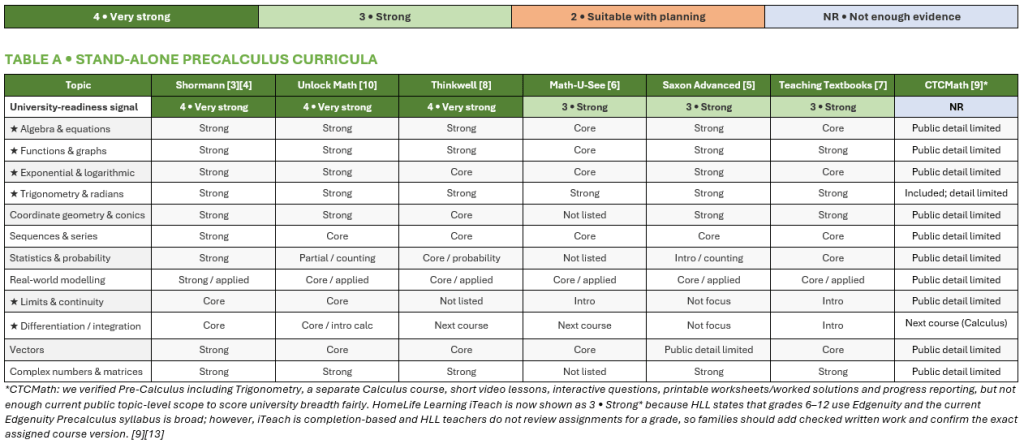
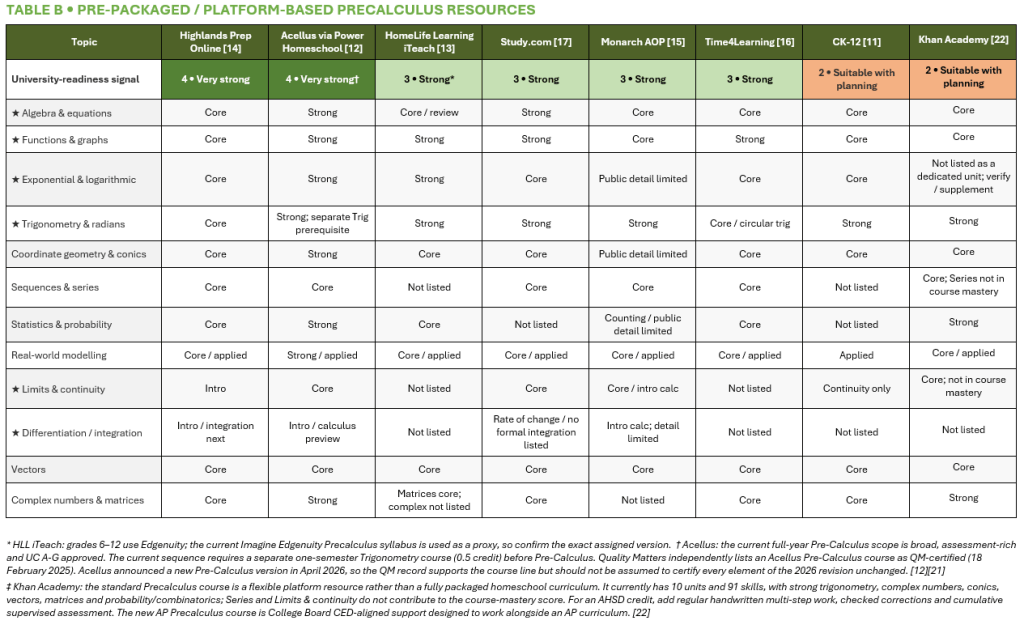
All the options in Tables A and B below can therefore form the mathematics resource within a Kairos/HLA plan, provided the exact course and resource are recorded correctly and the learner’s credit and tertiary plan are checked.
Table A groups stand-alone mathematics curricula that a family can select. Table B groups Precalculus delivered through broader online platforms flexible resource systems. The grouping describes delivery model and is not a quality hierarchy.
A Part 1-style topic comparison
THE COURSES SIDE BY SIDE
The ratings below describe published curriculum scope, not the quality of a teacher, the learner’s final mark or formal qualification equivalence.
- Strong = unusually broad/advanced coverage is explicit;
- Core = a substantial stated part of the course; Intro = introductory/review coverage;
- Next course = the provider places the main topic in the following course;
- Not listed = not a significant item in the public scope reviewed;
- Public detail limited = not enough current public detail to classify confidently.
The columns are arranged from stronger to more planning-dependent options. The signal reflects verified public course breadth, assessment/cumulative-review evidence and how much additional course design a family must supply.
Published topic breadth alone is not treated as proof of student outcomes; external course-design or approval evidence can strengthen confidence where it is relevant. We use “NR” when current public scope or assessment evidence is still too limited for a fair readiness judgement. Options sharing a signal are not finely ranked, and learner fit still matters.
| A cost and access note for Kairos families Our HLA model does not require every family to purchase one fixed curriculum package. E.g. Kairos families can access Highlands Prep Online through our partnership discount and may also use Acellus through Power Homeschool as a curriculum resource. Cost does matter, but it should not override course fit or independent evidence of mastery. Record the exact resource in the child's Education Plan and keep the wider AHSD and tertiary goal in view. [2][12][14] |
Different strengths for different learners
WHAT STOOD OUT TO US
A reassuring finding from this review is that families have several sound choices. The differences matter most when the learner has a mathematics-heavy destination, needs a particular teaching style, or is likely to need more (or less) day-to-day scaffolding.
For the broadest preparation for calculus-heavy study, Shormann, Unlock Math, Thinkwell, Highlands Prep Online and Acellus stand out most clearly in this review. Their published scopes give families a strong base for keeping Engineering, mathematical sciences and other quantitative routes open.
For learners who need a mastery-based or more scaffolded route, Math-U-See, Teaching Textbooks, Monarch and Time4Learning may be very good educational fits. Importantly, a learner already thriving in Math-U-See does not need to change simply because another Precalculus course looks broader; the coherent Math-U-See PreCalculus → Calculus sequence is a sound option when the learner is ready, with any destination-specific gaps checked separately. [6]
Study.com, Khan Academy and CK-12 are flexible and content-rich resources, but the family or teacher carries more responsibility for turning the material into a coherent, assessed school course with sufficient written work and cumulative review. Khan Academy is particularly useful as a free teaching and practice platform; for a full Precalculus credit, verify exponential/logarithmic preparation and assess Series and Limits & continuity deliberately rather than relying only on the platform mastery score. [11][17][22]
This is where learner fit becomes important. A highly rigorous course that a student cannot engage with consistently may produce less mastery than a well-chosen, well-supported course that the learner can actually complete with understanding.
Matching the course to the learner and destination
WHAT WE WOULD RECOMMEND
These are curriculum recommendations, not university admission rulings. We are recommending by likely academic demand and verified course content, then refining by learning style. The learner still has to meet the complete AHSD, USAf and university/ programme requirements. [1][2]
| Likely tertiary direction | Courses we would consider first | Why |
| Engineering; Mathematics; Physics; calculus-heavy Computer/Data Science | Strong first options: Shormann, Unlock Math, Thinkwell, Highlands Prep Online or Acellus. If a learner is already thriving in Math-U-See, continuing through Math-U-See PreCalculus and then Calculus is also a sound continuity option. | These routes need strong algebra/functions/logarithms/ trigonometry and independent problem solving. Acellus has broad verified content and formal assessments, but requires the separate Trigonometry prerequisite and should still include handwritten multi-step work. With Math-U-See, check/supplement gaps such as matrices, complex numbers or Statistics where relevant, then add Calculus when foundations are secure. [6][12][21] |
| Actuarial Science; Financial Mathematics; Econometrics; Quantitative Risk/ Analytics | Strong first options: Shormann; also consider Highlands Prep, Thinkwell or Unlock with deliberate Statistics planning. A successful Math-U-See learner can continue to Calculus, but should add/ verify probability and Statistics. | Actuarial and quantitative commerce require strong functions/logs/trigonometry, with probability, Statistics and later Calculus carrying extra weight. Acellus includes substantial probability/combinatorics inside Pre-Calculus, but a dedicated Statistics course may still be appropriate for the intended degree. [12] |
| General BCom; Accounting; Business Management | Good fits to consider: Thinkwell, Math-U-See, Teaching Textbooks, Monarch or Time4-Learning. Continue to Calculus only when the intended programme benefits from it and the learner is ready. | General commerce is not automatically a calculus-heavy destination. Confident algebra, functions, logarithms, data interpretation and accurate problem solving matter greatly. A focused mastery or scaffolded course can therefore be a better educational fit than choosing maximum breadth for its own sake. |
| Learner still undecided and capable of strong Mathematics | Prefer breadth: Shormann, Unlock Math, Thinkwell or Highlands Prep Online. If Math-U-See is already working well, continue the sequence and plan Calculus rather than switching without a clear reason. | When the future direction is uncertain, preserve options without sacrificing mastery. Secure Precalculus first; Calculus can then extend the pathway for a capable learner. |
| Learner is not yet ready for true Precalculus | Use a bridge honestly before Precalculus. | A bridge such as Denison Advanced Algebra & Trigonometry may be the wiser educational choice. Denison itself says it is preparation for Precalculus, not a Precalculus credit. [18] |
| A note about BCom BCom is not one mathematics category. General BCom and Business Management may have very different school-Mathematics thresholds and first-year mathematics from Actuarial Science, Econometrics or Financial Mathematics. Part 1 explains why the exact programme matters. [1] |
Which learning style may suit which course?
MATCHING THE COURSE TO THE STUDENT
| Learner profile | Potentially good fit | Why / caution |
| Enjoys rigorous written work, cumulative review and a spiral approach | Shormann; Saxon Advanced if already using Saxon successfully | Dr Shormann combines continual review with broad modern Precalculus content. Saxon remains a strong incremental spiral route, although DIVE now recommends Shormann Precalculus as its updated alternative. [3][5] |
| Learns best from a strong video lecturer | Thinkwell | Hundreds of short professor-led videos, automatic practice and formal tests. A strong fit for auditory/visual learners who still work problems actively. [8] |
| Wants broad automated online STEM preparation | Unlock Math; Acellus via Power Homeschool | Both publish broad advanced scopes with automated feedback. Acellus adds structured unit, mid-term and final assessment and has external course-design/approval signals; its current route also requires a separate one-semester Trigonometry prerequisite. For either programme, require handwritten working and periodic cumulative checks rather than relying only on automated completion. [10][12][21] |
| Needs mastery and a less crowded sequence | Math-U-See | The focused mastery sequence can suit a learner who benefits from one layer at a time. If Math-U-See is already producing genuine mastery, continuing PreCalculus → Calculus is usually preferable to changing brands merely for breadth. For mathematics-heavy destinations, separately check matrices, complex numbers and probability/Statistics. [6] |
| Needs substantial scaffolding and indepen-dent day-to-day work | Teaching Textbooks | Animated teaching, hints, step-by-step solutions and automatic grading reduce parent teaching load. Require handwritten working and periodic no-hint cumulative checks. [7] |
| Values a Christian online course and self-paced structure | Monarch AOP | A full-year Christian online course with functions, trigonometry, polar work, sequences and limits. Good family fit can matter; verify the advanced depth needed for the intended degree. [15] |
| Prefers multimedia and a standard high-school core | Time4Learning | A clear online Precalculus route covering functions, trigonometry, complex numbers, matrices, analytic geometry and sequences. Suitable for many learners, with handwritten and cumulative work still important. [16] |
| Needs short, rewindable explanations and low-friction practice | CTCMath | Short, rewindable 4–9 minute tutorials, interactive questions, printable worksheets/worked solutions and reports can reduce cognitive load. Pre-Calculus includes Trigonometry and a separate Calculus course follows. We retained NR because the current public topic-by-topic Precalculus list could not be independently inspected in enough detail. [9] |
| Needs a packaged/support route rather than only a stand-alone maths curriculum | Highlands Prep Online; HomeLife Learning (HLL) iTeach | Highlands publishes a broad Precalculus/ Calculus sequence and is available as a Kairos family resource. HLL iTeach lists Pre-Calculus and delivers grades 6–12 through Edgenuity; its current Precalculus proxy scope is broad, but iTeach is completion-based, so confirm the assigned version and add checked written work. [13][14] |
| Family/teacher wants maximum flexibility and will manage assessment | Study.com; CK-12; Khan Academy, | Study.com offers a broad self-paced course; Khan Academy provides strong free instruction and practice; CK-12 provides a flexible Precalculus FlexBook. All three need intentional written assessment and transcript planning when used inside the AHSD. For Khan Academy, do not use the platform mastery percentage as the complete course mark. [11][17][22] |
| Has dyscalculia / significant number-sense or working-memory difficulty | Prioritise fit and mastery; often Math-U-See, CTCMath or Teaching Textbooks, depending on the learner | Do not automatically lower the mathematical destination. Slow the pace, reduce cognitive load, use visual/manipulative support and explicit cumulative review, and use specialist intervention where needed. See Kairos: Dyscalculia Support – Best Maths Programs for Your Child. [20] |
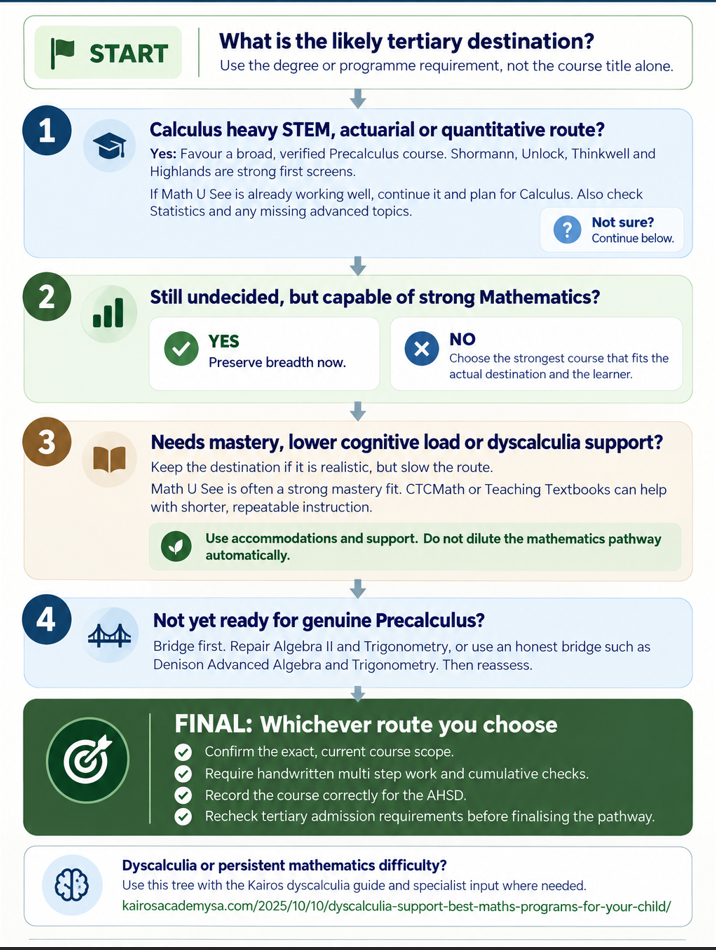
A simple decision tree for choosing the mathematics route
BEFORE YOU DECIDE
Frequently asked questions
QUESTIONS FAMILIES OFTEN ASK US
Does Precalculus have to include Calculus?
No. A strong traditional Precalculus course can prepare a learner very well without a large Calculus unit. Secure algebra, functions, logarithms and rigorous trigonometry come first. Introductory limits, derivatives or integrals are useful when the foundation is already secure.
Does Shormann also have Calculus after Precalculus?
Yes. Shormann Precalculus itself includes meaningful introductory Calculus, and Shormann Calculus I is a separate next course. The Calculus progression is therefore a strength of the Shormann sequence, not a feature unique to Acellus or other online programmes. [3][4]
Which options would you consider first for Engineering?
On the current evidence reviewed here, we would recommend that you first screen Shormann, Unlock Math, Thinkwell, Highlands Prep Online and Power Homeschool, then choose according to the learner. Alternatively, a student already succeeding with Math-U-See can reasonably continue PreCalculus → Calculus rather than switch brands, provided any destination-specific gaps are checked. The deciding evidence should be retained mastery and independent problem solving, not syllabus breadth alone. [6][12][21]
Which options would you consider first for Actuarial Science?
Prioritise a strong functions/logarithms/trigonometry base and deliberate probability/Statistics planning. Shormann and Power Homeschool are especially convenient because its published scope is broad; Highlands Prep, Thinkwell and Unlock are also strong screens with Statistics checked or added. A successful Math-U-See learner can continue into Calculus and could add/verify Statistics rather than assume Precalculus covers it. [6][12]
What about a general BCom learner?
Do not automatically apply an Engineering benchmark to every BCom. Thinkwell, Math-U-See, Teaching Textbooks, Monarch or Time4Learning may be excellent pure-Mathematics routes when they fit the learner. If quantitative commerce remains possible, choose one of the broader routes.
Can a learner go to tertiary study with Mathematical Literacy?
Yes, where the exact programme explicitly accepts it. This article intentionally does not compare those routes; it focuses on the pure-Mathematics/AHSD Precalculus pathway. See Part 1 for the wider admission-readiness discussion. [1]
The goal is readiness, not simply a course title
IN CONCLUSION
For a future engineer, actuary or mathematician, we would deliberately recommend breadth and rigor, then continue into Calculus and/or Statistics when the learner is ready. For a learner already succeeding with Math-U-See, that may simply mean continuing the same sequence into Calculus rather than changing curricula unnecessarily. For general commerce, a more focused or scaffolded course may produce stronger fluency and confidence.
There is rarely only one workable choice. The aim is to steward the decision wisely: choose mathematics that is strong enough for where the learner may be going, teach it in a way this learner can genuinely engage with, and assess honestly enough to know what has been mastered. That combination matters far more than an impressive course title.
| We are here to help Kairos Academy SA works alongside families to plan AHSD credits, choose curriculum with the future in mind and keep the mathematics pathway aligned with the learner’s strengths and likely tertiary direction. You do not need every future detail settled before making the next wise decision. |
Explore the American High School Diploma Pathway for South African Families • Frequently Asked Questions • KAIROS+ planning and consultation support
Sources and editorial notes
SOURCES AND EDITORIAL NOTES
This article was checked against current public course descriptions, scope-and-sequence documents, platform information and, where available, independent evidence. Provider claims were not treated as independent proof of rigor. User reviews were treated as anecdotal context, not scoring evidence. Where evidence remained insufficient, we have said so. The readiness signal is a curriculum-analysis judgement, not outcome research. Last reviewed: 24 September 2026.
1. Kairos Academy SA: Part 1 - Is This Grade 12 Mathematics Pathway Sufficient for University in South Africa? A family guide to school-leaving mathematics and university readiness. Accessed 23 September 2026.
2. HomeLife Academy: Curriculum Options HLA states that families choose their own curriculum/resources; with separate Education Plan guidance for recording requirements. Accessed 23 September 2026.
3. DIVE/Shormann: Shormann Precalculus with Trigonometry Course resources, teacher guide and scope. Accessed 23 September 2026.
4. DIVE/Shormann: Shormann Calculus I samples and teacher guide Next-course progression. Accessed 23 September 2026.
5. Rainbow Resource / DIVE: Saxon Advanced Mathematics (2nd ed.) Current legacy-course description and topic scope. Accessed 23 September 2026.
6. Math-U-See's PreCalculus and Calculus - current scope/sequence confirms a mastery pathway through PreCalculus into a one-year high-school Calculus course. Accessed 24 September 2026.
7. Teaching Textbooks: Pre-Calculus Version 4.0 Course format, support features and official table of contents. Accessed 23 September 2026.
8. Thinkwell Homeschool: Precalculus Course format, assessment structure and detailed table of contents. Accessed 23 September 2026.
9. CTCMath: Its Homeschool programme / How It Works confirms Pre-Calculus including Trigonometry, separate Calculus, 4–9 minute tutorials, interactive questions, printable worksheets/worked solutions and reporting; current public topic-level Precalculus detail remained insufficient for a fair breadth rating. Accessed 24 September 2026.
10. Unlock Math: Pre-Calculus Lesson-by-lesson honors-level scope and assessment model. Accessed 23 September 2026.
11. CK-12 / K12 LibreTexts: Precalculus Public CK-12 FlexBook table of contents. Accessed 23 September 2026.
12. Power Homeschool's Acellus April 2026 Pre-Calculus release and scope, Trigonometry prerequisite/separate semester course, and UC A-G approved-course list. Accessed 24 September 2026.
13. HomeLife Learning / Imagine Edgenuity: HLL confirms iTeach grades 6–12 use Edgenuity; current Edgenuity Precalculus syllabus used as a content proxy; iTeach is completion-based. Accessed 24 September 2026.
14. Highlands Prep Academy: Public catalogue located during this review; includes detailed Precalculus and Calculus descriptions. Accessed 23 September 2026.
15. AOP Monarch: Pre-Calculus Current full-year online Pre-Calculus description and scope. Accessed 23 September 2026.
16. Time4Learning: current high-school Precalculus scope. Accessed 24 September 2026.
17. Study.com Precalculus High School, 26 chapters / 205 lessons, including conics, polar coordinates, continuity and limits. Accessed 24 September 2026.
18. Denison Algebra: Advanced Algebra & Trigonometry Explicitly identifies AAT as a bridge and not a Precalculus credit. Accessed 23 September 2026.
19. Hawai‘i State Department of Education: 2020 Acellus instructional review; 56 specialists, 84 reviews across 50+ courses; most reviewers would not recommend the assigned resource, with low cognitive demand a recurring concern. Historical evidence only; not a review of the 2026 Pre-Calculus course. Accessed 24 September 2026.
20. Kairos Academy SA: Dyscalculia Support: Best Maths Programs for Your Child Practical guidance on visual support, manipulatives, pacing and curriculum fit. Accessed 24 September 2026.
21. Quality Matters: A public certified-course database lists “Acellus Pre-Calculus” (International Academy of Science, course 00001080) as QM-certified on 18 February 2025. QM K-12 certification evaluates alignment of learning objectives, assessment, instructional materials, learner activities, technology, support and accessibility against its rubric. Because Acellus announced a new Pre-Calculus version in April 2026, this is supportive independent course-design evidence but not proof that every element of the 2026 revision is unchanged. Accessed 24 September 2026.
22. Khan Academy's PreCalculus: Standard course, currently 10 units / 91 skills; Series and Limits & continuity do not count toward course mastery. Khan Academy Blog: AP Precalculus. 2026 College Board CED-aligned support designed to work alongside the AP mathematics curriculum. Accessed 24 September 2026.
#kairosacademysa #excellence #community #integrity