Home education is fully legal in South Africa, offering families the freedom to pursue a personalized educational journey. To assist you in your planning and decision-making, we’ve outlined key information below:
- The South African School’s Legal Landscape – A homeschooler’s perspective on navigating the current legal framework.
- School Requirements – A comprehensive overview of our diploma program in partnership with HomeLife Academy (HLA), including graduation requirements and our Code of Ethics.
- Tertiary Applications in South Africa – Insights into the recognition of our diploma through SAQA and USAf.
Additionally, our families benefit from access to the Pestalozzi Trust, ensuring legal support and peace of mind when needed.
The SA School’s Legal Landscape
Grade R-9 students
Yes, homeschooling in South Africa is legal. Its legal framework is defined by the South African Basic Education Laws Amendment (BELA) Act, 2024, published on 16 September 2024 (pending enactment), and the South African Home Education Policy, 2018, and applies to Grade R-9 learners.
It is important to note that the BELA Act does not replace the South African Schools Act (SASA),1996 or the Employment of Educators Act, 1998, but rather serves as an amendment to these existing laws, refining and updating specific provisions to address contemporary educational challenges, with key updates revolving around updated governance provisions for public and independent schools, clarified requirements for homeschooling and compulsory school attendance, and defined the mandatory registration processes for learners.
While the South African Home Education Policy, 2018 continues to provide a framework and guidelines for homeschooling, the BELA Act incorporates certain elements of this policy into law, making them legally enforceable. For example:
- Homeschool learners in Grades R–9 must be registered with their provincial Department of Basic Education (DBE).
- Compliance with the Curriculum and Assessment Policy Statement (CAPS) is legally required.
- Penalties may apply for non-compliance.
Thus, while the policy remains a valuable reference for parents, the BELA Act takes precedence in legal and enforcement matters.
Key Aspects of Homeschooling under the BELA Act and Home Education Policy:
- Legal Recognition:
Homeschooling is affirmed as lawful under SASA and strengthened by BELA. - Registration:
Parents must register their children with their provincial education department to fulfill legal obligations. - Parental Responsibility:
Parents are required to ensure the education provided meets or exceeds the standards of public schooling, including covering essential subjects. - Flexibility in Approach:
The policy allows parents to adopt diverse educational methods, such as eclectic, classical, or alternative curricula, tailored to their children’s needs. - Flexibility in Approach:
The Home Education Policy allows parents to choose diverse curricula, e.g. classical, eclectic, alternative, provided learners meet minimum CAPS-aligned standards. - Accountability:
Parents must maintain records of their children’s progress and ensure that educational outcomes align with required standards.
Homeschooling in South Africa thus offers flexibility and personalization while requiring adherence to legal requirements to ensure quality education.
Kairos’ Support
At Kairos, we continue to offer support to our families and Grade R-9 students. We do this through consultation and planning, administrative support, and helpful templates. Additionally, we provide community and our Applecore recordkeeping system through our HLA partnership. Our blog on How the BELA Act affects homeschooling will provide further and valuable insight.
Legal Support
The Pestalozzi Trust is “a registered public benefit organisation that supports its members when they come into conflict with the authorities in connection with their homeschooling.” We recommend that our families become Pestalozzi Trust members for legal advice and support. And through Kairos, you qualify for a 10% membership discount.
Our School’s Requirements
Grades R-8
Education for our Grade R-8 students are aligned with the SASA requirements. Parents guide the learning journey, while Kairos supports planning and recordkeeping where sourced. Also consider further guidance here from our school partner based on age and grade range:
Grades 1-3, Grades 4-6, and Grades 7-8.
Grades 9-12
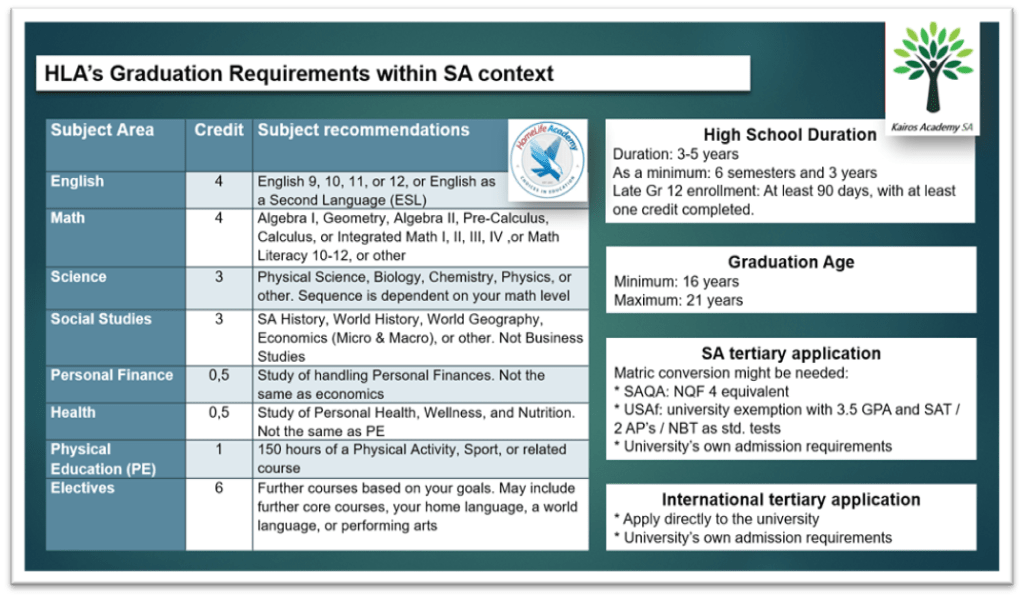
Our Diploma enables our students to begin working toward their diploma upon starting Grade 9-level subjects in English and Mathematics.
To graduate, students must fulfill the minimum subject requirements outlined in the table below. However, they are encouraged to explore additional subjects aligned with their interests and goals. Academically motivated students often go beyond the minimum, typically completing an average of 6–8 subjects per year.
The standard duration for completing the diploma is four years, though this can vary based on individual needs. Accelerated students may graduate in as little as three years, while those needing additional time can extend their studies to five years.
To graduate through Kairos Academy SA in partnership with HLA, students must be between 16 and 21 years old and fulfill all academic and credit requirements:
Code of Ethics
We value the integrity of our families and partners, and we look forward to building on this foundation with each new family that joins us.
Both Kairos and HLA have earned a strong reputation for successfully placing students in universities worldwide. Our program is thoughtfully designed to equip students for success, with well-established processes to support academic placement in post-secondary institutions. For further details, please refer here:
AHSD Recognition in South Africa
Our HLA-issued American High School Diploma is an international qualification. For South African university access, three key bodies are involved:
SAQA – South African Qualifications Authority
- Role: Verifies authenticity of your diploma and benchmarks it on the National Qualifications Framework (NQF)
- Outcome: Our Diploma is typically recognized as NQF Level 4, equivalent to the National Senior Certificate (NSC), without a Bachelor’s Pass
- Duration: they state 90 days. Some of our families reported quicker, with others substantially longer.
- Application portal: SAQA Authentication Services
- Their process: SAQA’s application process-as on 15 Dec 2025
SAQA Cost: R2,270 — for your Diploma and Transcript evaluation
USAf – Universities South Africa
- Role: Governs matriculation exemptions for Bachelor studies for students with non-South African school-leaving qualifications
- Operates under the Higher Education Act, 1997
- Application for your USAf application is now directly through your university of choice. Follow-up with your university with that exact process and its timelines. Expected cost: R1,000.
- Uses criteria outlined in Government Gazette No. 31674 of 5 December 2008, with specific assessment under paragraph 31 (Senate Discretionary admissions route) or under paragraph 40, at which time the following requirements are needed:
- High School Diploma with a GPA ≥ 3.5 plus one of the following:
- SAT: Composite score ≥ 1130 (ERW ≥ 610, Math ≥ 530)
- Two AP subjects: Scores 3–5 on College Board AP exams
- National Benchmark Tests (NBTs):
- “Proficient” AL, QL & MAT for STEM-related programmes
- “Proficient” AL & QL for non-STEM programmes
- High School Diploma with a GPA ≥ 3.5 plus one of the following:
Where Our Students Go
We are blessed to have students continuing their studies both locally and abroad, including locally at NWU, Stellenbosch, STADIO, Open Window, Tuks, and Eduvos for degrees purposes (including MBChB, B.Ing., B.Com, B.Sc., and B.A.).
Note that both UP and Wits have highlighted that they do not accept students through the USAf Paragraph 31 (Senate) process.
Let’s build something great together!

Excellence in Education… since 2013
 Kairos Academy SA