
Frequently Asked Questions (FAQ’s)
American High School Diploma Pathway with Kairos Academy SA
Choosing a school-leaving pathway is a meaningful decision for any family. At Kairos Academy SA, we support South African families from Grade R to Grade 12 through a flexible American High School Diploma pathway in partnership with HomeLife Academy.
This pathway offers structure without unnecessary rigidity. Families retain freedom of curriculum and resource choice, while still working within a recognised high school framework with credits, transcripts, Applecore recordkeeping, graduation requirements, and South African-context guidance.
Our heart is to help families make wise, informed decisions that support academic growth, character development, family values, and future opportunities. We believe education is part of faithful stewardship: helping each child grow in wisdom, character, skill, and purpose.
Below you will find answers to our Frequently Asked Questions (FAQ)’s.
The American High School Diploma, or AHSD, is a high school completion pathway where subjects are recorded as credits, grades are captured on a transcript, and the student works toward graduation requirements through our school partner, HomeLife Academy.
It is not one fixed curriculum package. Families may choose suitable online programmes, textbooks, tutors, parent-led learning, projects, sport, arts, entrepreneurship, service, practical learning, and other meaningful learning experiences.
The key is that the learning must be appropriate, well planned, assessed, and clearly recorded.
HomeLife Academy provides the AHSD framework, graduation requirements, transcript structure, Applecore recordkeeping system, and official transcripts and diplomas.
Kairos Academy SA provides South African-context guidance, family support, planning resources, Applecore guidance, consultations, transcript support, webinars, and help with pathway decisions.
Parents remain actively involved in choosing resources, overseeing learning, keeping evidence, and shaping the student’s education according to the child and family context.
Yes, the American High School Diploma can support South African tertiary pathways when it is planned and recorded carefully.
It is important to understand the difference between a valid school-leaving credential, matriculation exemption, and admission to a specific university or degree.
South African public universities usually require proof that a student qualifies for bachelor-level entry. For students with international or foreign-equivalent school-leaving qualifications, this often involves the Universities South Africa Matriculation Board, also known as USAf. USAf exemption and university admission are connected, but they are not the same thing. A student may still need to meet the specific admission requirements of the university, faculty, and degree.
For the American High School Diploma, USAf’s published information includes routes involving the diploma together with recognised admission evidence, AP exams, SAT/ACT scores, or, for certain South African AHSD candidates, a case-by-case paragraph 40 condoned ordinary conditional exemption route where the student meets specified GPA and benchmark requirements.
This is why we encourage families to plan early, especially from Grade 9 onward. The AHSD pathway can be a strong and flexible option, but it must be aligned with the student’s likely future direction.
No. The American High School Diploma and the GED are not the same.
The GED is a high school equivalency testing route. The American High School Diploma through HLA is a full high school pathway where students complete subjects over time, earn credits, build a transcript, and work toward graduation requirements.
This distinction is very important for South African families, especially where university admission may be part of the long-term plan.
| Area | American High School Diploma via Kairos/HLA | GED |
|---|---|---|
| Structure | Full high school pathway with subjects, credits, grades, transcript, and diploma | High school equivalency testing route |
| Duration | Usually completed over several high school years | Exam-based route |
| Subjects | Broad subject selection across English, Mathematics, Science, Social Studies, Personal Development, and electives | Tested through GED subject areas |
| Academic record | Student builds a transcript over time | Based primarily on GED test results |
| Flexibility | High flexibility in resources, pacing, electives, and learning approach | Less flexibility in how the final credential is generated |
| Tertiary planning | Can support local and international applications when well planned | May be more limited in some South African university contexts |
| Best fit | Families wanting a full high school pathway with flexible learning and structured records | Students needing an equivalency route |
We encourage families to choose a pathway that supports both the student’s current season and future opportunities. We at Kairos only provide the AHSD.
No. Kairos Academy SA does not prescribe one fixed curriculum.
This is one of the strengths of the pathway. Families may choose resources that fit their child, family values, budget, academic goals, learning style, and future direction.
Some families use structured online programmes. Others use textbooks, parent-led teaching, tutors, Charlotte Mason resources, Classical Conversations, unit studies, practical projects, or a combination of several approaches.
Kairos helps families understand how to plan and record this learning well within the AHSD framework.
Families have broad subject flexibility, especially in the high school years.
Typical high school subject areas include English, Mathematics, Sciences, Social Studies, Personal Finance, Health and Wellness, Physical Education, Fine Arts, Technology, Business, Accounting, Entrepreneurship, Economics, Foreign Languages, South African languages, and electives linked to the student’s strengths, interests, future studies, or practical skills.
For Grade R to Grade 8, families should ensure that learning remains broad, age-appropriate, and aligned with strong academic foundations.
For high school students, subject choices should be planned with graduation requirements, transcript quality, and possible tertiary pathways in mind.
Subject choice should be based on the student’s age, academic level, strengths, interests, family vision, and possible future direction.
For younger students, the priority is strong foundations in reading, writing, Mathematics, communication, thinking skills, character, and healthy learning habits.
For Grade 7 and 8 students, we recommend beginning high school readiness planning without creating unnecessary pressure.
For Grade 9 to 12 students, subject planning becomes more important because formal high school credits are being earned. At this stage, families should consider graduation requirements, transcript quality, South African tertiary expectations, and possible career or study pathways.
If your student is approaching high school, transferring from another system, or keeping university options open, a Graduation Plan Consultation is often the best next step.
Students must meet HomeLife Academy’s graduation requirements to receive the American High School Diploma.
The AHSD is usually built through credits earned from Grade 9 onward. A full-year high school subject is usually recorded as 1 credit, while a semester course is usually recorded as 0.5 credit.
Many students complete approximately 5 to 6 credits per year during high school. Academically strong or highly motivated students may complete more, but we encourage families to prioritise meaningful learning and transcript quality rather than simply accumulating credits.
Planning should always consider the whole student: academic readiness, future goals, workload, character growth, and family capacity.
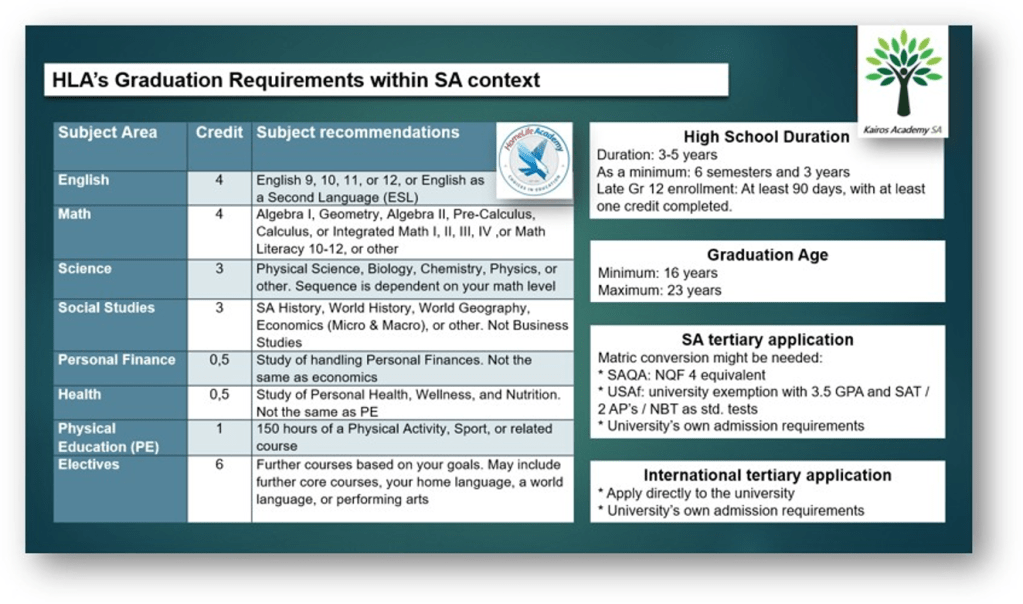
In the American system, high school subjects are recorded as credits.
A full-year high school course is usually worth 1 credit. A semester course is usually worth 0.5 credit.
A subject can usually be recorded for credit when the work is high school level, has suitable content, includes meaningful assessment, and is recorded clearly.
Credits may come from online courses, textbooks, tutor-led courses, parent-led courses, practical learning, projects, sport, arts, entrepreneurship, or other appropriate learning experiences.
Good records matter. Families should keep evidence of the work completed and report accurately in Applecore.
Our blog, What are High School credits?, provides further insight.
They may be needed, depending on the student’s future plans.
For South African public university admission, families should research the specific institution, faculty, and degree requirements. USAf exemption, SAQA evaluation, GPA, SAT, NBT, AP exams, and institutional criteria may each play a role depending on the pathway.
USAf’s published information for AHSD candidates completed in South Africa includes case-by-case consideration where a student has a good GPA of at least 3.5 and meets specific benchmark requirements such as SAT, AP, ACT, or NBT criteria.
For private South African institutions, requirements may differ. Some may use internal admission processes, SAQA evaluation, placement tests, interviews, portfolios, or other criteria.
For international universities, requirements vary widely. Some may ask for SAT, AP exams, English language tests, portfolios, or other evidence.
The safest approach is to start researching tertiary requirements early, especially before Grade 11. This allows families to make wise subject and assessment decisions before the final year.
Yes, many students use the American High School Diploma for tertiary study locally and internationally.
However, university admission is never automatic for any school-leaving pathway. Each institution and faculty may have its own requirements.
Students who are considering competitive degrees, such as Engineering, Medicine, Health Sciences, Law, Education, Commerce, Design, or international study, should plan carefully. English, Mathematics, Sciences, Languages, Social Studies, GPA, course level, and benchmarking tests may all become important.
Kairos encourages families to plan according to the student’s real strengths, possible destination, and future opportunities rather than from fear or comparison.
USAf matriculation exemption and SAQA evaluation are not the same process.
USAf matriculation exemption relates to eligibility for first-degree study at South African universities. It is usually relevant for students with international or foreign-equivalent school-leaving qualifications who wish to study at a South African public university.
SAQA evaluation determines the level on the South African National Qualifications Framework at which a foreign qualification should be recognised. SAQA evaluation may be required by a tertiary institution, employer, professional body, or other process.
Some students may need USAf processes. Some may need SAQA evaluation. Some may need both, depending on where they apply and what the institution requires.
Families should always confirm requirements directly with the university, institution, or professional body involved.
Yes. Many families transfer to Kairos/HLA from CAPS, IEB, Cambridge, GED-related pathways, online schools, eclectic homeschool programmes, or other international systems.
Previous records are valuable, but they need to be reviewed carefully. School reports, transcripts, course records, completed work, grade levels, assessment methods, and academic rigour may all influence how previous learning can be interpreted for AHSD credit planning.
For high school transfer students, Kairos recommends a Graduation Plan Consultation. This helps families understand which previous work may contribute toward graduation, where gaps may exist, and which subjects or credits still need to be completed.
Usually no formal transfer credit process is needed for primary school students.
For younger learners, families should focus on appropriate placement, strong foundations, healthy learning habits, and a broad education. It is still helpful to keep records, especially where the family needs evidence for their own planning or legal responsibilities.
No. Kairos does not register families or students with the Department of Basic Education or provincial education departments.
In South Africa, home education registration and legal compliance remain the parent’s responsibility. The DBE describes home education as an alternative to attending public or independent schools where a parent of a compulsory-school-age learner provides education at home. Parents apply to the head of the Provincial Education Department.
Kairos and HLA provide a supportive educational environment, planning guidance, recordkeeping support through Applecore, community support, and the AHSD school-of-record framework. Kairos does not act as a DBE registration agent and does not monitor DBE registration compliance on behalf of families.
Families should familiarise themselves with the applicable South African home education requirements and make their own informed decisions.
Families should keep suitable records of the child’s learning.
The DBE lists records such as attendance, a portfolio of the child’s work, up-to-date progress records, evidence of educational support, evidence of continuous assessment, evidence of assessment or examination at the end of each year, and evidence at the end of Grades 3, 6, and 9 showing whether the child has achieved the outcomes for those grades.
For Kairos/HLA families, Applecore supports academic recordkeeping, but parents should also keep their own practical evidence of work completed. This is especially important for younger compulsory-school-age learners and for high school students preparing for transcripts, transfer, graduation, or tertiary applications.
In many cases, yes, but placement decisions remain with the receiving school.
A well-kept academic record can support school transfers. Families should keep clear records of subjects, resources, grades, and completed work. For high school students, the HLA transcript may be useful when transferring to another school or applying for further study.
If a return to a South African school is a strong possibility, families should plan with that in mind and keep records especially carefully.
Kairos families may follow one of two academic calendars:
The ALPHA Calendar, which broadly follows a January to December rhythm.
The US Standard Calendar, which broadly follows a July/August to June/July rhythm.
Both calendars lead to the same AHSD framework, but the calendar affects enrollment timing, reporting deadlines, transcript release dates, graduation rhythm, and planning flow.
Kairos has a dedicated calendar page to help families compare these options more clearly.
If you are unsure which calendar fits your family best, consider your child’s current school year, transfer timing, reporting rhythm, and graduation goals.
No. Kairos and HLA do not charge monthly school fees.
Fees are usually once-off per enrollment, re-enrollment, or selected Kairos+ service. Families budget separately for their chosen curriculum, online programmes, tutors, books, activities, or other resources.
This makes the pathway cost-effective and flexible because families can choose resources that suit their budget and educational priorities.
Enrolled Kairos families receive access to key support structures, including the Kairos e-Planner, Kairos communication channels, community support, webinars, guidance resources, and Applecore recordkeeping through HomeLife Academy.
The Kairos e-Planner is a detailed planning resource with stepwise guidance, helpful links, and practical information to support families through the year.
Many families can move forward confidently with these included resources. Families who need more individualised help may choose optional Kairos+ services.
Kairos+ services are optional added support services for families who want more personalised guidance, practical planning, review support, or administrative assistance.
These may include:
- Kick-Start Consultation: a short consultation for new families who need initial direction.
- Graduation Plan Consultation: a detailed planning service that includes a personalised report and a 60-minute consultation. This is especially useful for Grade 7 to 12 families, transfer students, and families considering tertiary pathways.
- Calibrate Consultation: a shorter review consultation for existing Kairos families who need help adjusting or reviewing their current plan.
- Transcript Review: a review of the student’s high school record to support transcript accuracy, subject continuity, course titles, credit allocation, graduation readiness, or tertiary applications.
- Administrative Support: practical help with Applecore planning, semester reporting, course descriptions, summaries of assessment, subject records, and documentation support.
- Educational Assessments: where applicable, these may support families needing additional educational insight or reporting support.
Applecore is HomeLife Academy’s online recordkeeping system.
Families use Applecore to manage education plans, courses, grades, attendance, and academic records. These records support transcript quality and graduation readiness.
Applecore access is included with enrollment.
Families remain responsible for reporting accurately, but Kairos provides guidance and optional administrative support where needed.
Yes. Kairos offers Applecore guidance as part of its general support.
Families who want practical help with loading education plans, reporting grades, recording attendance, or managing Applecore information may add Kairos+ Applecore Support.
This service can be especially helpful for new families, busy families, or families who feel uncertain about recordkeeping.
Good recordkeeping protects the student’s pathway.
Families should keep suitable records of subjects, resources, assessments, grades, attendance, course descriptions, and evidence of completed work.
For high school students, course descriptions and assessment summaries can be especially helpful. These records support planning, reporting, transcript reviews, tertiary applications, and transfer situations.
Kairos offers templates and documentation support for families who need help creating course descriptions, assessment spreadsheets, or subject records.
Marks may come from tests, assignments, projects, essays, written work, practical work, portfolios, oral presentations, resource-generated grades, exams, or a combination of assessment methods.
The best assessment method depends on the subject, resource, grade level, student, and learning goals.
Families should aim for fair, evidence-based marks that reflect the student’s actual learning. Where tutors or online programmes are used, those marks may often form part of the student’s final grade.
For Grade R to Grade 9, South African families should remain aware of South African educational expectations and the broad foundation that learners need.
Kairos families often go beyond minimum expectations because they can personalise learning and choose rich resources.
For high school students working toward the AHSD, planning shifts toward credits, transcript quality, graduation requirements, and future tertiary alignment. However, South African context still matters, especially for learners who may apply to local universities.
Yes. Families may use tutors, learning centres, co-ops, Classical Conversations communities, online providers, parent-led teaching, or blended support.
However, parents remain responsible for choosing the learning environment carefully, overseeing the student’s education, keeping records, and ensuring that reporting is accurate.
Kairos and HLA provide the framework, guidance, and recordkeeping pathway. Tutors and learning centres may support implementation, but they do not replace the parent’s responsibility.
Families should also ensure that any learning centre or tutor arrangement is suitable, transparent, and aligned with their legal and educational responsibilities.
Yes. Families may choose faith-based resources where these fit the subject, grade level, and learning goals.
Many Kairos families value the ability to continue personalised education, intentional character formation, and family-centred learning while working toward a recognised school-leaving pathway.
Families may also choose secular or mixed resources. The pathway allows freedom of resource choice, provided the learning is appropriate and well recorded.
Yes, where the learning is appropriate, planned, assessed, and recorded well.
Practical learning may form part of electives, Physical Education, Fine Arts, Technology, Entrepreneurship, Life Skills, service learning, or other suitable subject areas.
Not every activity needs to become a high school credit. Families should record learning intentionally and avoid overloading the transcript with unnecessary credits.
The question to ask is: Does this learning have enough structure, time, evidence, and assessment to be recorded meaningfully?
Start simply.
First, clarify your family vision. Consider your child’s strengths, your values, educational priorities, character goals, and possible future direction.
Second, understand the AHSD pathway. Learn the basics of credits, transcript, GPA, Applecore, calendar choice, graduation requirements, and recordkeeping.
Third, choose the right next support. You may download the Starter Guide, watch the webinar, request a fee estimate, enroll directly, or book a consultation.
You do not need to understand every detail before taking the first wise step
A Graduation Plan Consultation is recommended when your child is approaching high school, entering Grade 9 to 12, transferring from another system, or when you want to keep South African or international tertiary options open.
It is also helpful for Grade 7 and 8 families who want to understand the road ahead without creating unnecessary pressure.
The consultation includes a review of the information provided, a personalised report, a 3 to 6 year plan where relevant, a 60-minute consultation, and an updated report where needed.
The goal is not to lock your family into one rigid plan. The goal is to help you make informed decisions within a flexible framework.
Families should avoid waiting until Grade 12 before checking credit progress.
It is also wise to avoid choosing resources without considering academic level, assuming all previous work will automatically transfer, keeping too little evidence, overloading the student out of fear, ignoring language or Mathematics requirements for specific degrees, or confusing flexibility with lack of planning.
The AHSD pathway can be flexible, academically meaningful, and well aligned with a student’s future when it is planned wisely and recorded carefully.
Final encouragement
Your child’s educational journey does not need to look exactly like another family’s journey.
For families who value personalised education, character formation, family involvement, and freedom of choice, the American High School Diploma pathway can be a practical and hopeful solution.
At Kairos Academy SA, we are here to help families move forward with wisdom, clarity, and confidence. Education is about more than subject selection. It is about preparing children for meaningful work, faithful service, wise stewardship, and a life lived with purpose.
 Kairos Academy SA